
The Ultimate Cadillac Eldorado Wire Wheel Fitment Guide: 1953–2002

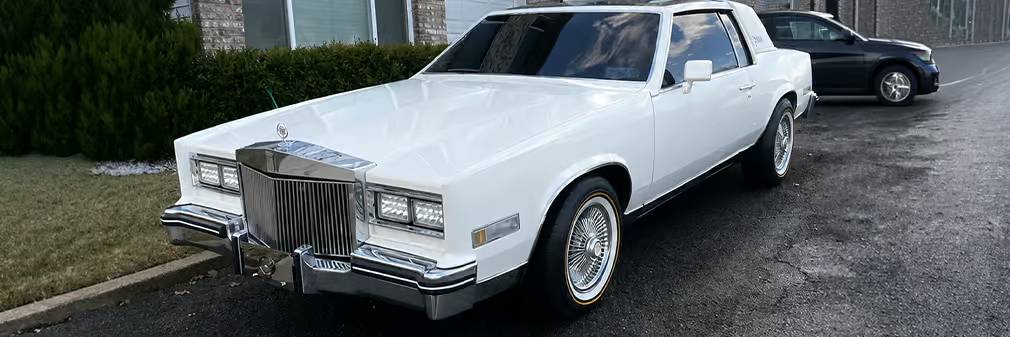
The Cadillac Eldorado is one of the most recognizable American luxury cars ever built, and few upgrades complement its long body, chrome trim and classic styling like a properly fitted set of wire wheels.
But choosing wire wheels for an Eldorado isn’t as simple as selecting a diameter.
Across its long production history, the Eldorado changed dramatically. Earlier models used traditional rear-wheel-drive architecture, while the Eldorado became front-wheel drive beginning in 1967. Later generations also changed bolt patterns, suspension geometry, brake packages and factory wheel offsets.
Add rear fender skirts, lowered suspension, hydraulic or air-ride setups, knock-off adapters and oversized wheels into the equation, and two Eldorados that look similar can require completely different wheel setups.
This guide covers Cadillac Eldorado wire-wheel fitment from classic 15-inch lowrider setups through 20-, 22-, 24-, 26- and extreme custom applications.
Important: This guide is intended as a starting point for custom fitment. Always verify the exact vehicle, brake clearance, suspension, wheel offset/backspacing and available fender clearance before ordering.
Quick Cadillac Eldorado Wire Wheel Fitment Chart
| Eldorado Years | Drive Layout | Common Bolt Pattern | General Fitment Direction |
|---|---|---|---|
| 1950s–1966 | RWD | Verify exact year | Classic/standard fitment |
| 1967–1978 | FWD | Commonly 5×5 / 5×127 | Early-FWD fitment; measure carefully |
| 1979–1985 | FWD | 5×4.75 / 5×120.65 | Positive/FWD-style fitment generally preferred |
| 1986–1991 | FWD | 5×115 | High-positive/FWD-style fitment |
| 1992–2002 | FWD | 5×115 | High-positive/FWD-style fitment |
The bolt pattern is only one part of proper fitment. Offset, backspacing, adapter thickness, brake clearance, tire width, suspension height and fender-skirt clearance can be equally important.
Why Cadillac Eldorado For Wire Wheel Fitment Is Different
The Eldorado presents a unique challenge because the nameplate spans several completely different chassis designs.
A wire wheel that looks perfect on a 1965 Eldorado may sit far outside the body of a later FWD Eldorado.
Likewise, a wheel that clears a stock-height vehicle may rub badly after the same Eldorado is lowered.
Before choosing your setup, consider five major factors:
- Model year and generation
- RWD versus FWD architecture
- Wheel width and offset
- Fender skirts
- Suspension height and intended stance
Your desired appearance matters too. Some owners want everything tucked beneath the body, while others intentionally want a more aggressive outward stance.
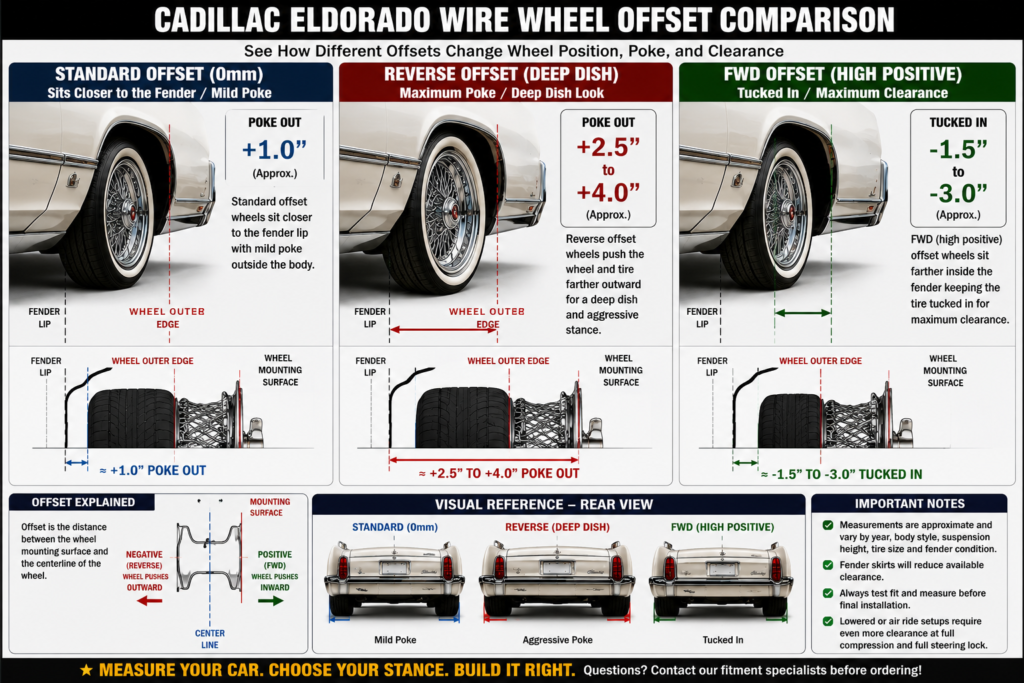
Understanding Standard, FWD and Reverse Wire Wheels
Traditional wire wheels are commonly available in several fitment configurations.
Standard Offset Wire Wheels
A standard configuration generally places the wheel closer to a traditional near-zero-offset position.
On compatible classic vehicles, this creates the recognizable wire-wheel appearance with a visible outer lip without pushing the wheel as aggressively outward as a reverse wheel.
Standard wire wheels can work extremely well on many older vehicles, but that does not mean a standard-offset wheel automatically fits every Eldorado.
Later FWD cars generally require substantially different wheel positioning.
FWD / High-Positive-Offset Wire Wheels
FWD wire wheels move the mounting surface farther toward the outside face of the wheel, allowing more of the wheel and tire to sit inward.
This is especially important on later front-wheel-drive Eldorados where the factory suspension geometry was designed around positive-offset wheels.
For many 1986–2002 Eldorados, this is the starting point when the goal is a clean, tucked installation.
Reverse Wire Wheels
A reverse wheel creates the classic deep-dish appearance by positioning more of the wheel barrel outward from the mounting surface.
The result is substantially more lip and substantially more poke.
Reverse wire wheels can create an incredible custom appearance, but they are not a universal Eldorado fitment.
On later FWD Eldorados, reverse fitment can push the wheel and tire dramatically outside the factory body line.
Tucked vs Flush vs Poke: Decide What Look You Want
There isn’t one universally “correct” custom Eldorado stance.
Tucked Fitment
The tire remains comfortably inside the outer body line.
This is usually the safest approach for:
- Factory fender skirts
- Stock-body restorations
- Later FWD Eldorados
- Cars driven regularly
- Vehicles where minimizing rubbing is the priority
Flush Fitment
The outer wheel or tire approaches the fender line without dramatically extending beyond it.
This provides a stronger custom appearance while maintaining a relatively clean body profile.
Poke Fitment
“Poke” means intentionally positioning the wheel farther outward so part of the wheel or tire extends beyond the factory body line.
For certain custom builds, poke is intentional—not a fitment mistake.
Standard or reverse wire wheels may be used to create this appearance on suitable vehicles, but the more aggressively the wheel moves outward, the more carefully you need to evaluate:
- Fender clearance
- Tire width
- Steering clearance
- Suspension travel
- Ride height
- Fender skirts
- Wheel bearing load
- Adapter position
A show-oriented setup and a comfortable highway cruiser may therefore require completely different wheel specifications.
1950s–1966 Cadillac Eldorado Wire Wheel Fitment
These earlier Eldorados represent the classic American luxury-car formula: enormous body dimensions, rear-wheel drive and substantial wheel wells.
For owners trying to preserve the period-correct appearance, 15-inch wire wheels with whitewall tires remain one of the most natural combinations.
Popular styles include:
- 15×7 wire wheels
- Chrome wire wheels
- Gold-center wire wheels
- Traditional knock-off styling
- Whitewall tires
A slightly larger 17- or 18-inch wheel can modernize the vehicle without completely changing its classic proportions.
Because specifications vary across these early years, confirm the exact year, hub dimensions, brakes and bolt pattern before purchasing.
1967–1978 Cadillac Eldorado Wire Wheel Fitment
This is where Eldorado fitment becomes particularly interesting.
The 1967 Eldorado introduced front-wheel drive, despite the car retaining the huge dimensions associated with traditional American luxury cars.
That means you should not assume that the enormous body automatically provides traditional RWD wheel fitment.
These vehicles commonly use a 5×5-inch / 5×127 bolt pattern, but wheel positioning remains critical.
Best Classic Setup
For a traditional luxury/lowrider appearance, consider:
- 15-inch wire wheels
- Tall whitewall tires
- Conservative wheel positioning
- Chrome or gold-center finishes
Larger Custom Setups
17-, 18- and 20-inch wheels can also work beautifully when properly specified.
22-inch and larger wheels become increasingly dependent on the individual vehicle’s ride height, tire size and fender configuration.
And then there is the biggest Eldorado-specific issue:
fender skirts.
Cadillac Eldorado Wire Wheels With Fender Skirts
Rear fender skirts can completely change the fitment equation.
The skirt occupies valuable space directly outside the rear tire. A wheel that would otherwise clear the quarter panel may interfere with the skirt.
If you plan to retain your factory skirts, prioritize:
- Conservative tire width
- Correct positive/inward wheel positioning
- Adequate suspension-travel clearance
- Spinner/knock-off clearance
- Tire sidewall clearance
Do not choose a wheel simply because the bolt pattern matches.
A deep reverse wheel that moves the tire several inches outward can make retaining the factory skirts extremely difficult.
Eldorado Fitment Without Fender Skirts
Removing the rear skirts provides considerably more freedom.
Without the skirt occupying the outer wheel opening, owners can explore:
- More visible wheel lip
- Wider wheels
- Larger diameters
- Flush fitment
- Intentional poke
- More aggressive custom stances
However, removing the skirt doesn’t make clearance unlimited. The tire still needs to clear the quarter panel through the suspension’s entire range of movement.
1979–1985 Cadillac Eldorado Wire Wheel Fitment
The 1979 redesign produced a significantly smaller Eldorado while retaining front-wheel drive.
These cars commonly use a 5×4.75-inch / 5×120.65 bolt pattern and require much more attention to positive offset than traditional RWD classics.
These Eldorados are excellent candidates for classic lowrider-inspired wire-wheel builds, particularly in smaller diameters.
Popular directions include:
- 15-inch classic wire wheels
- 17-inch restomod setups
- 18-inch cruiser setups
- 20-inch custom setups
Owners wanting standard or reverse wheels for additional poke should measure carefully before ordering.
1986–1991 Cadillac Eldorado Wire Wheel Fitment
The Eldorado became smaller again for 1986 and moved to the 5×115 bolt pattern used by later models.
These cars generally favor positive-offset/FWD-style wheel fitment.
If the goal is to keep the tire inside the factory body line, an FWD-style wire wheel is normally the better starting point.
Standard or reverse wheels may create substantial outward positioning.
That doesn’t necessarily mean they can never be used on a custom build—it means the installation should be treated as custom fitment rather than guaranteed factory-style fitment.
1992–2002 Cadillac Eldorado For Wire Wheel Fitment
The final-generation Eldorado is another popular candidate for custom wheels, especially the Eldorado Touring Coupe.
These cars use a 5×115 bolt pattern and factory-style wheel positioning with substantial positive offset.
For a clean street setup, FWD/high-positive-offset wire wheels are generally the appropriate starting point.
Using a near-zero standard wheel changes the stance substantially.
Using a deep reverse wheel changes it even more.
Depending on the exact wheel specifications, this can move the tire significantly toward—or beyond—the outer fender.
For that reason, later Eldorados should be measured carefully before ordering traditional wire wheels.
15-Inch Cadillac Eldorado Wire Wheels
For a classic lowrider or restoration-inspired build, it’s hard to beat 15-inch wire wheels.
Best for:
- Classic Eldorados
- Lowriders
- Period-correct builds
- Maximum sidewall
- Comfortable cruising
Common wheel widths include 15×7 and, where appropriate, 15×8.
Possible tire sizes depending on the vehicle include:
- 205/75R15
- 215/70R15
- 215/75R15
- 235/75R15
A tall whitewall makes the setup look especially natural on older Eldorados.
17-Inch Cadillac Eldorado Wire Wheels
A 17-inch wheel is an excellent option for someone who wants to retain classic proportions while adding a more modern appearance.
A 17×8 wire wheel provides noticeably more wheel presence than a traditional 15 without forcing the extremely low-profile tires associated with oversized setups.
One common tire-size starting point for appropriate applications is 225/50R17, although the exact tire should be chosen around the specific Eldorado year and desired overall diameter.
18-Inch Cadillac Eldorado Wire Wheels
18-inch wire wheels sit between classic and modern styling.
They work especially well for restomod-style builds where the owner wants:
- More wheel presence
- Reasonable tire sidewall
- Modern tire availability
- Better balance between comfort and appearance
Wheel offset becomes increasingly important as width and diameter increase.
20-Inch Cadillac Eldorado Wire Wheels
For many custom Eldorado builds, 20-inch wire wheels are one of the best compromises between visual impact and practical drivability.
A 20×8 configuration provides a much stronger custom appearance while still allowing meaningful tire sidewall.
Potential tire sizes include options around:
- 235/40R20
- 245/40R20
- 245/45R20
The correct choice depends heavily on generation and available clearance.
For later FWD Eldorados, wheel offset is just as important as tire size.
22-Inch Cadillac Eldorado Wire Wheels
22-inch wire wheels transform the appearance of an Eldorado.
At this size, the vehicle takes on a much more aggressive custom luxury-cruiser profile.
A 22×8 wheel is generally easier to package than wider configurations.
Possible low-profile tire starting points include:
- 245/30R22
- 255/30R22
- 265/35R22 on applications with sufficient clearance
Do not assume these sizes are interchangeable.
The difference between a 245/30R22 and 265/35R22 is substantial in both width and overall diameter.
With 22-inch setups, check:
- Front turning clearance
- Fender clearance
- Strut/suspension clearance
- Rear skirt clearance
- Ride height
- Effective wheel offset
24-Inch Cadillac Eldorado Wire Wheels
A 24-inch setup moves firmly into custom-show territory.
Depending on the generation, 24×9 wire wheels may require body, suspension or steering-clearance modifications.
Common custom tire sizes may include:
- 255/30R24
- 275/25R24
But neither should be treated as a universal Eldorado tire size.
At this diameter, an inch of wheel positioning can make the difference between a functional setup and severe rubbing.
Measure before ordering.
26-Inch Cadillac Eldorado Wire Wheels
26-inch wire wheels should be considered a custom fabrication-level fitment on an Eldorado rather than a normal bolt-on upgrade.
Potential modifications can include:
- Fender modifications
- Inner-liner trimming
- Suspension changes
- Steering-clearance work
- Ride-height changes
- Removal of fender skirts
Low-profile tires such as 275/25R26 are commonly used in the broader 26-inch custom-wheel market, but compatibility must be evaluated on the actual vehicle.
Can You Put 28-Inch Wire Wheels on a Cadillac Eldorado?
Anything is possible in a sufficiently customized show build, but a 28-inch Eldorado should not be presented as a simple wheel-and-tire swap.
At this level, expect extensive custom fitment work.
The build should be planned around the wheel and tire package rather than purchasing wheels first and trying to make the vehicle accommodate them afterward.
Knock-Off vs Bolt-On Wire Wheels for Cadillac Eldorado
This is one of the most overlooked parts of wire-wheel fitment.
Knock-Off Wire Wheels
Traditional knock-off wire wheels mount through an adapter system and use a spinner or knock-off to secure the wheel.
They provide the authentic classic wire-wheel appearance associated with lowriders and vintage luxury builds.
But the adapter itself affects the effective position of the wheel.
Therefore, you can’t evaluate knock-off fitment from wheel offset alone.
The complete installation needs to account for:
hub + adapter + wheel + knock-off + tire.
Brake-caliper clearance must also be verified.
Direct Bolt-On Wire Wheels
Bolt-on wire wheels attach more like conventional wheels and can simplify certain applications.
For later-model vehicles with large brakes or difficult adapter clearances, a properly engineered bolt-on configuration may be the more practical choice.
When deciding between knock-off wire wheels and bolt-on wire wheels, choose based on the actual vehicle and intended use—not appearance alone.
Cadillac Eldorado Whitewall Tire Options
Few combinations complement an Eldorado better than wire wheels and whitewall tires.
Older cars generally look natural with taller sidewalls and wider classic whitewalls, while larger wheels require proportionally shorter sidewalls.
Popular custom directions include:
- Classic wide whitewalls
- 1-inch whitewalls
- 1.5-inch whitewalls
- Thin whitewalls
- Whitewall with gold stripe
- Whitewall with red stripe
The correct whitewall width should complement both the wheel diameter and the era of the vehicle.
A large whitewall can look perfect on a 15-inch classic setup while overwhelming a low-profile 22- or 24-inch tire.
Lowered, Hydraulic and Air-Ride Eldorados
Never determine fitment from stock specifications alone if the suspension has been modified.
Lowering changes the relationship between the wheel, tire and body.
A wheel that clears perfectly at normal ride height can contact the fender when the suspension compresses.
For lowered or air-ride Eldorados, check clearance at:
- Normal driving height
- Full steering lock in both directions
- Compressed suspension position
- Lowest intended show height
Hydraulic lowrider builds require additional attention because suspension movement can be considerably greater than on a stock vehicle.
How to Measure Your Eldorado Before Ordering Wire Wheels
Before ordering a custom wheel package, collect the following information:
1. Exact year
“Cadillac Eldorado” alone isn’t enough.
A 1972 and a 1997 Eldorado require completely different fitment strategies.
2. Current wheel and tire size
This provides a useful baseline for calculating changes in width and overall diameter.
3. Fender skirts
Tell your wheel specialist whether the vehicle has skirts and whether you intend to keep them.
4. Suspension
Specify whether the vehicle is:
- Stock height
- Lowered
- On coilovers
- Air ride
- Hydraulics
5. Brakes
Factory drum, factory disc and aftermarket brake conversions can all create different clearance requirements.
6. Desired stance
Tell the fitment specialist whether you want:
- Tucked
- Flush
- Mild poke
- Aggressive poke
A picture of the stance you’re trying to achieve can be extremely useful.
Common Cadillac Eldorado Wire Wheel Fitment Mistakes
Buying by Bolt Pattern Alone
A 5×115 wheel isn’t automatically correct simply because the Eldorado has a 5×115 bolt pattern.
Offset and brake clearance matter too.
Ignoring Fender Skirts
A wheel can clear the quarter panel while still contacting the skirt.
Assuming Every Eldorado Is RWD
It isn’t.
The Eldorado switched to FWD beginning in 1967, which makes its wheel history very different from many other classic Cadillacs.
Assuming Every FWD Eldorado Uses the Same Fitment
They don’t.
The chassis, bolt patterns and factory wheel positioning changed across generations.
Choosing Reverse Wheels Based Only on Lip Depth
That beautiful deep lip comes from moving wheel width outward.
Make sure the car has somewhere for that additional width to go.
Forgetting About the Adapter
On a knock-off setup, evaluate the complete assembly—not simply the wheel’s advertised specifications.
Choosing the Tire After Buying the Wheel
The tire should be part of the fitment calculation from the beginning.
Wheel diameter, tire width, sidewall height and overall diameter all work together.
Frequently Asked Questions About Cadillac Eldorado Wire Wheels
What size wire wheels fit a Cadillac Eldorado?
Depending on the year and build, Eldorados can use everything from classic 15-inch wire wheels to 20- and 22-inch custom setups. 24-inch and larger applications should generally be treated as custom fitments requiring substantially more clearance evaluation.
Are Cadillac Eldorados front-wheel drive?
Eldorados from 1967 through the end of production in 2002 are front-wheel drive. Earlier Eldorados used rear-wheel-drive architecture.
What bolt pattern does a Cadillac Eldorado have?
It depends on the year. Eldorados have used multiple bolt patterns during their production history, including 5×5 / 5×127, 5×4.75 / 5×120.65 and 5×115 applications. Always verify the exact model year before ordering.
Can I put 20-inch wire wheels on a Cadillac Eldorado?
Many Eldorados can be built with 20-inch wire wheels when the correct width, offset and tire size are selected. Later FWD models generally require more positive wheel positioning than traditional RWD classics.
Can I put 22-inch wire wheels on an Eldorado?
Yes, 22-inch wheels are used on custom Eldorado builds, but clearance becomes more critical. Tire diameter, wheel offset, steering clearance, suspension and fender skirts should all be checked.
Can I put 24-inch wheels on a Cadillac Eldorado?
24-inch wheels are possible on custom builds, but they should not be treated as universal bolt-on fitment. Some applications may require suspension or body-clearance modifications.
Can you put 26-inch wheels on a Cadillac Eldorado?
It is possible on heavily customized vehicles, but 26-inch Eldorado setups should be considered custom projects. Modifications may be required depending on generation, suspension and desired stance.
Can I use reverse wire wheels on a Cadillac Eldorado?
It depends heavily on the year and desired stance. Reverse wheels move more of the wheel outward and can produce substantial poke. This may work for certain custom builds but can create major clearance problems on later FWD Eldorados or vehicles retaining fender skirts.
Can I keep my fender skirts with wire wheels?
Yes, but skirt clearance substantially limits how far outward the wheel and tire can sit. Conservative inward positioning and appropriate tire width are particularly important.
Are knock-off wire wheels compatible with an Eldorado?
They can be on appropriate applications, but adapter fitment, brake clearance, wheel position and spinner clearance must all be verified.
Should I choose standard or FWD wire wheels for my Eldorado?
It depends primarily on the year and desired stance. Later FWD Eldorados generally favor high-positive/FWD-style wheel positioning when the goal is keeping the tire inside the body. Older cars and custom poke builds can have different requirements.
What’s the best Eldorado wire wheel size for a classic look?
A 15-inch wire wheel with a taller whitewall tire produces the most traditional appearance on many classic Eldorados.
What’s the best size for a custom cruiser?
20-inch wheels are an excellent middle ground for many custom builds because they provide substantially more wheel presence without requiring the extremely short sidewalls associated with 22-, 24- or 26-inch packages.
Will wire wheels fit an Eldorado with aftermarket disc brakes?
Possibly, but brake conversions can change caliper clearance significantly. Measure the brake package before ordering, particularly when using knock-off adapters.
Find the Right Wire Wheel Setup for Your Cadillac Eldorado
There is no single wheel specification that fits every Cadillac Eldorado from the 1950s through 2002.
That’s exactly why proper fitment starts with the car, not the wheel.
Before selecting your setup, identify your Eldorado’s:
Year + suspension + brakes + fender skirts + desired wheel diameter + desired stance.
Whether you’re building a classic Cadillac on 15-inch chrome wires and whitewalls, a lowrider with gold-center wheels, or an oversized custom cruiser on 20- or 22-inch wheels, matching the complete wheel-and-tire package to the vehicle is what produces the right stance.
Measure first. Choose the stance second. Then build the wheel and tire package around the available space.


